
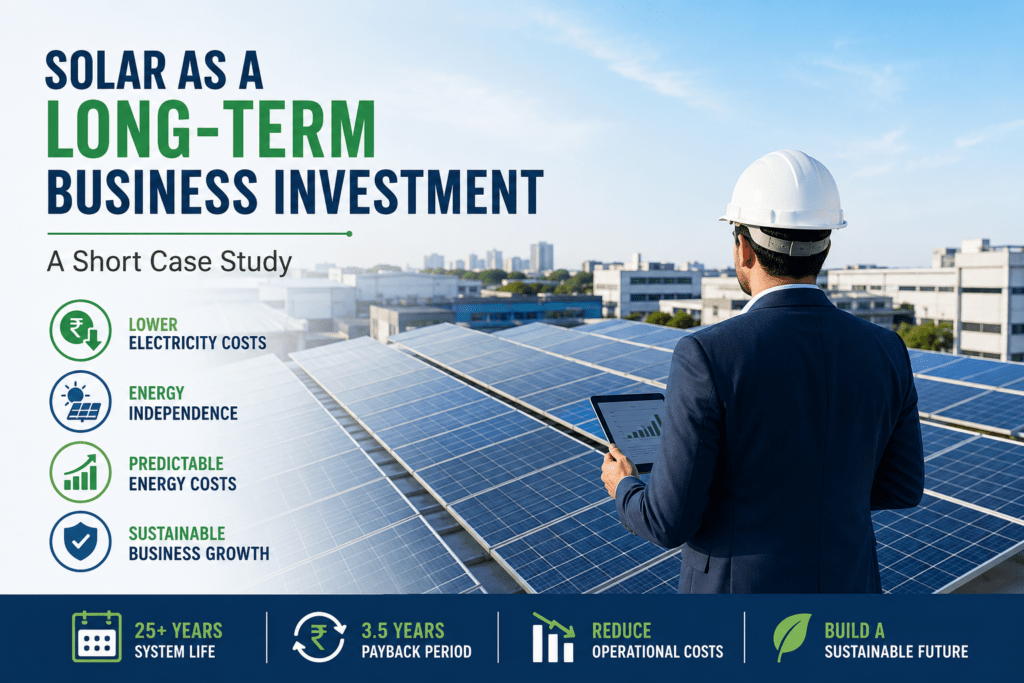
Solar as a Long-Term Business Investment: A Short Case Study
What if a business could reduce its electricity costs while investing in an asset that keeps producing value for years? This is what makes businesses and companies invest in commercial solar power plants. Yes, we are talking about solar as a long-term business investment here.
For organizations with predictable and high electricity consumption, investing in solar as a long-term investment may ensure high ROI (Return-On-Investment) while reducing costs and ensuring energy independence. Rather than depending solely on grid electricity, businesses can successfully generate all or a part of their energy requirement via solar power plant.
Apart from reduced electricity bills, businesses get other benefits out of this arrangement, including improved energy planning and protection from ever-increasing energy costs. But the success of such a project depends on factors like proper planning, good system design, installation, performance, and routine maintenance.
Why Should Businesses Consider Solar as a Long-Term Investment?
There are several obvious reasons businesses should invest in solar projects as a long-term investment:
Lowering Electricity Costs
Electricity consumption leads to huge business expenses for an organization as it is used in their offices, warehouses, and factories. A commercial solar power plant may effectively lower a business’ dependency on grid electricity and decrease monthly electricity bills.
Ensuring Business Operations Efficiently
Solar systems generate electricity during daylight hours. It often matches the operating schedules of various commercial facilities. Businesses can use this power directly to support their daily operations.
Improving Cost Predictability
Despite the initial investment requirement, a solar project might predict future energy expenses. Hence, a business may, in advance, find out projected energy generation and potential savings throughout the project’s operating life.
A Short Business Case Study
Think of a company that needs a huge amount of electricity every day to run its day-to-day operations. Their business-day-to-day electricity expenses compel them to look for ways to reduce dependency on grid electricity.
Management evaluates the rooftop solar project before making the investment. They determine their utility bills, roof space availability, electricity usage, solar electricity generation, installation cost, and maintenance.
The firm approaches a ‘solar EPC Company’ for evaluating the site and designing the appropriate system. The EPC Company evaluates the roof, electrical structure, solar generation, equipment needed, and financial viability of the system.
The firm adopts a ‘commercial solar power plant’ as per its own energy needs.
Investment Factor | How It Matters? |
Available space | Ground-mounted area or rooftop |
Energy consumption | Expected and present electricity requirements |
Energy savings | Potential reduction in grid electricity use |
Installation cost | Engineering, equipment, and project work |
Maintenance | Long-term operating requirements |
Where Does the Long-Term Value Come From?
Long-Term Power Generation
A solar project creates electricity for a solar year. After investing once, businesses are to continue using the project to counterbalance some portion of their electricity use.
Increased Control over Energy Costs
By having a solar plant, businesses can have better control over their energy costs. The production of some energy lowers their dependency on variable energy costs.
Evaluating the Investment
Solar energy cannot ensure a certain profit automatically. Before investing, companies need to evaluate many factors, including the costs of the system, electricity costs, financing, etc.
Savings and Financial ROI: Before and After Solar Installation
Financial Metric | Before Solar Installation | After Solar Installation |
Grid Energy Dependency | 100% | 20% |
Average Power Bill (Monthly) | ₹4,500,000 | ₹900,000 |
System Lifespan | N/A | 25+ Years |
Estimated System Payback Period | N/A | 3.5 Years |
Installation and Maintenance Matter
The solar power plant installation quality affects how the whole system will function in the future. Good design, correct choice of equipment, electrical work, safety procedures, and commissioning are all important here.
Companies need to think about the post-installation solar O&M services as well. Proper monitoring, inspection, cleaning, troubleshooting, and maintenance can make sure that the system will function efficiently.
Here comes the benefit of professional solar energy solutions. Besides equipment, businesses can assess the whole project, including its installation and post-installation phases.
What Factors Should Businesses Consider Beforehand?
Check Power Consumption
They should assess their own electricity consumption and identify how much solar energy can be utilized directly.
Assess Site Suitability
Rooftop or land availability, structural capabilities, sunlight availability, and installation conditions can influence project efficiency and price.
Consider Costs and Savings
The companies should consider the cost of installation against the energy savings. They should also look at the finance possibilities, subsidies, and legal regulations.
Think Long Term
Rather than keeping up with short-term trends in renewable energy, they should assess the long-term business sense of installing solar panels.
Conclusion
A solar power plant could be a lot more than just an alternative to on-grid electricity; it is an excellent long-term investment for businesses and companies. You can now see how companies can use solar power as a leverage in the long run.
But installing a commercial solar power plant and reaping long-term benefits require more than just a proper plan; businesses must do a feasibility study, assess total energy consumption, associated economic factors, installation quality, and routine maintenance, among other things.
FAQs (Frequently Asked Questions)
Q1. Will solar be a good long-term business investment?
Yes, because it can lower electricity costs in the long run, saving a significant amount of money.
Q2. What kinds of expenses are associated with a commercial solar power plant?
Electricity consumption, project cost, solar generation, financing, and maintenance.
Q3. Does a solar power project require routine maintenance?
Yes. Routine maintenance is essential.