
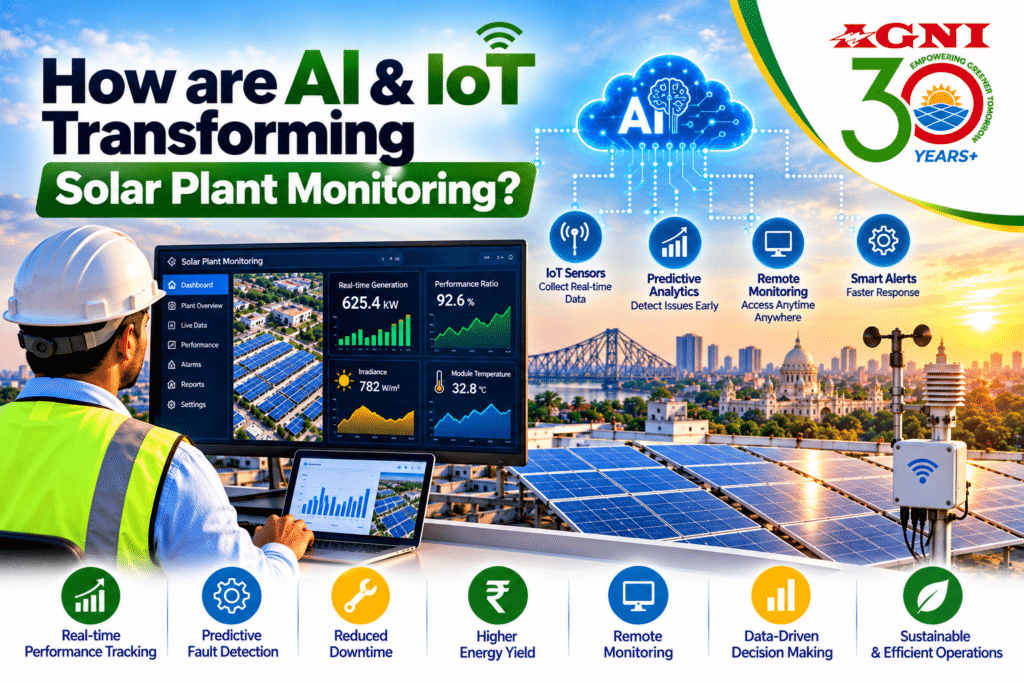
How are AI & IoT Transforming Solar Plant Monitoring?
What if a solar power plant could find an issue before it caused a major disruption in energy generation?
This is no longer a distant reality. AI (Artificial Intelligence) and IoT (Internet of Things) are already transforming how modern solar plants are monitored. They gather huge amounts of data, analyse it fast, and enable teams to make informed decisions. With solar projects getting larger and more complex, this is making smart monitoring more important than ever.
Why Smart Monitoring is Crucial for a Solar Plant?
A solar plant uses solar panels, inverters, cables, transformers, weather sensors, and many other items to produce electricity. Monitoring their operations ensures high efficiency and the identification of problems.
The traditional monitoring system involves regular checks and inspections, which are time-consuming and slow. Typical problems in the traditional monitoring of a solar plant include:
- Inability to notice small decreases in efficiency
- Continued problems for hours
- Lengthy manual analysis of data
IoT and AI can change the situation for the better. IoT devices collect data constantly, while AI analyzes this data and discovers any deviations from the norm.
How AI Enhances Solar Plant Monitoring?
Analyzes the Plant Performance
Artificial Intelligence analyzes a large volume of performance-related data quickly. It can compare current data with the historical data and detect some patterns that could indicate an emerging issue.
Identifies Equipment Issues
AI can also detect when a specific inverter generates less energy than other similar devices under the same weather conditions.
Helps in Predictive Maintenance
AI performs predictive maintenance as well. Instead of fixing some technical problems after their occurrence, it can use the historical and real-time data to make forecasts and prepare for maintenance.
Boosts Weather and Production Forecasting
Weather and production forecasting is another advantage of AI. It analyzes the weather conditions, irradiance, temperature, and previous generation patterns and makes future generation forecasts.
How IoT Connects Solar Equipment Together?
The IoT acts as a connecting bridge between physical solar equipment and digital monitoring systems. Sensors placed in the solar system can gather data like voltage, temperature, irradiance, current, humidity, and the condition of the equipment.
The IoT sensors continuously keep sending data to a central platform which operators can view the data using the remote monitoring system without having to visit all parts of the plant.
For big solar projects, it can save a lot of time, as the equipment can be monitored remotely from different locations and for problems.
The Magic of Combining IoT and AI
IoT and AI offer optimum performance when they work together. IoT gathers information, whereas AI analyzes the gathered information.
| Technology | Primary Role | How It Benefits? |
| IoT Sensors | Gathers real-time data | Better visibility |
| AI analytics | Analyzes operational data | Identifying problems quicker |
| Cloud Platforms | Store and process data | Centralized monitoring |
| Predictive models | Predict potential failures | Better management planning |
For instance, sensors can locate an abnormal increase in temperature of a solar inverter. This information is communicated to the AI model by the monitoring platform. The AI can match this with its history and compare it with other machines to find out if there is any abnormality.
This approach would make solar plant monitoring more proactive than reactive in nature.
Higher Efficiency and Quick Fault Detection
Some of the common issues in solar plants include shading, dirt build-up, equipment faults, communication failures, and abnormal temperatures. Minor faults could affect the output of solar energy production over time.
With AI-based monitoring, the system checks the discrepancy between the anticipated and actual performance to spot any deviations and assist technicians in identifying the faulty equipment.
Such a system is particularly helpful in a big solar PV power plant where several hundred or thousands of panels are used across a large geographical area.
Promoting Smarter Maintenance
Maintenance teams require accurate data for the maintenance scheduling process. This could be achieved by utilizing AI and IoT.
Today’s solar O&M services can make use of monitored data to determine the state of equipment, identify recurring issues, and prioritize maintenance tasks. Apart from relying on predetermined maintenance schedules, maintenance activities could also be done depending on the equipment’s current state.
For instance, in cases where sensors indicate that the equipment is performing as expected, no immediate inspections might be required. But in case of unusual data results, an inspection should be scheduled.
Such a condition-based approach can assist in reducing unnecessary maintenance.
The Crucial Role of Smart Solar Inverters and Chargers
Smart power converting devices are significant to solar power generation. A “solar inverter” is responsible for changing DC electricity generated by solar panels to usable AC electricity. Its monitoring regarding temperature, efficiency, voltage, and fault codes will be useful in determining the performance of the plant.
Just like a solar inverter, a solar MPPT charger can be used to track the maximum power point of the solar array and thus maximize the amount of energy harvested. Its operation condition monitoring will assist in identifying performance issues.
With IoT-based monitoring solutions, operators will be able to monitor the electrical performance of the plant.
What Lies Ahead?
AI, IoT, cloud computing, and advanced analytics are already making solar operations smarter and better. In the future, systems will be able to detect even more complicated equipment problems, accurately forecast power generation, and make more operational decisions through automation.
Digital monitoring can help with accurate reporting and performance analyses. Historical data enable operators to analyze seasonal trends, evaluate equipment performance, and maximize energy production.
With solar production continuing to rise, the practice of solar plant monitoring will start shifting towards intelligent decision-making.
Conclusion
AI and IoT are revolutionizing the work of solar panels by linking devices, gathering information, and processing complicated data into meaningful insight. Artificial intelligence identifies any anomalies and potential failures, while the Internet of Things allows operators to remain connected to their devices at all times.
Both technologies can potentially provide higher reliability, lower downtime, better maintenance, and improved performance. Therefore, modern operators of solar plants may rely on smart solar plant monitoring.
So what are you waiting for? Proceed to make the best use of AI and IoT to transform your solar plant monitoring too.
FAQs (Frequently Asked Questions)
Q1. What is solar plant monitoring?
It involves monitoring solar plants and their performance to boosts its energy production.
Q2. How does AI help solar plants?
AI helps by analyzing data from solar plants in order to pick out any strange patterns.
Q3. Is it possible to use IoT to check solar equipment remotely?
Yes, IoT devices can provide data on solar equipment that can be analyzed remotely.